
https://www.youtube.com/watch?v=oDKmEjh1pu4.
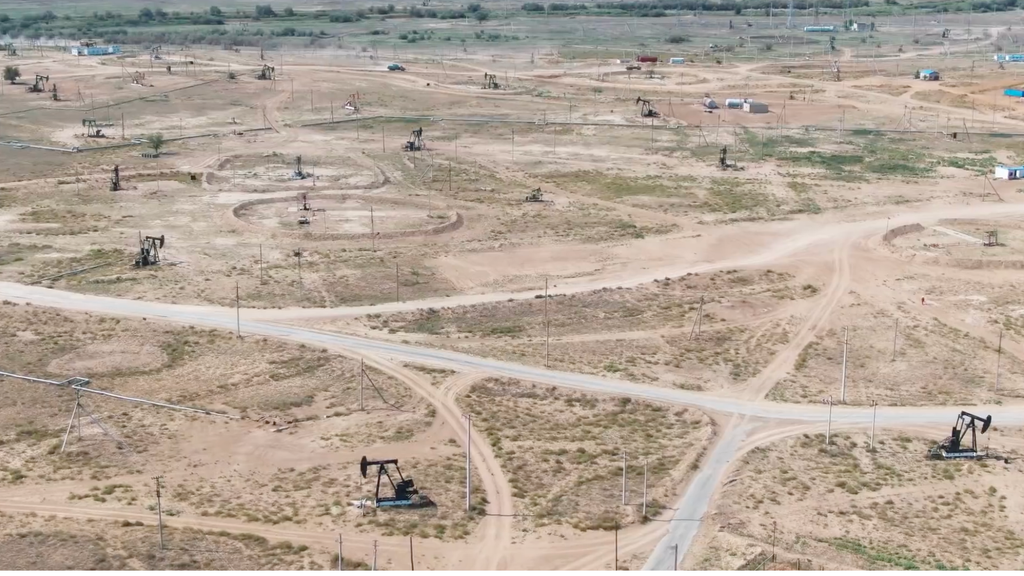
Over the past two years, Crude Accountability has been conducting comprehensive monitoring of the Kokzhide oil field in Kazakhstan, focusing on satellite imagery, real-time atmospheric monitoring, and ground-truthing.
Kokzhide is a protected natural reserve that contains a strategic subterranean freshwater aquifer capable of supplying all of western Kazakhstan with potable water, but it is also an oil field.
Operators at the Kokzhide field rely extensively on routine gas flaring. During flaring, methane (CH4), a potent greenhouse gas, and toxic hydrogen sulfide (H2S) are emitted directly into the atmosphere, along with the toxic greenhouse gases nitrogen dioxide (NO2) and sulfur dioxide (SO2), which all have climate, environmental, and human health impacts.
During Crude Accountability’s visit to the Kokzhide oil field, we observed giant flares with long smoke trails. Villagers confirmed that flaring takes place routinely. With our partners, Omanos Analytics and the Center for Climate Crime Analysis (CCCA), we documented routine flaring activity and emissions of methane, NO2, and SO2 at the site.
Remarkably, Kokzhide is characterized by anomalously high flaring intensity of 25 m3/bbl,1 five times the global average. NASA-JPL EMIT2 detected methane plumes from three distinct emission sources at Kokzhide. The first source emitted at a rate of approximately 1 ton per hour in 2023 and was dominated by lit tower flaring. The second source was characterized by intermittent small flaring events occurring at different sites at the wellheads. The third source emitted at a rate of 11 tons per hour in 2023 through flaring, venting, and incomplete combustion. At Kokzhide, methane super-emitter events are operating repeatedly at or below 90% DRE (destruction removal efficiency).3
Using the government’s air monitoring app, AirKz, Crude Accountability analyzed three months’ worth of air quality data from Kenkiyak and Shubarshi, two villages adjacent to the Kokzhide oil field. The results are striking: MPC (maximum permissible concentrations) exceedances for H2S, SO2, and NO2 occurred on 67 out of 92 days. H2S was prevalent: it occurred on 53 days, 47 of which exceeded the MPC by more than 2 times. These data suggest that the air in the villages of Kenkiyak and Shubarshi is chronically toxic, with hazardous industrial emissions occurring on 73% of observed days. Extreme concentrations of H2S mean that residents are being subject to severe, continuous chemical exposure, constituting a public health crisis.
The fight for clean water, clean air, and a healthy climate continues on the ground. On October 6th, the court held a preliminary hearing on declaring unlawful the inaction of governmental institutions4 regarding the state oversight, risk analysis, and protection of a body of water of special state significance—the Kokzhide underground water deposit. Environmental defenders demand the suspension of special water use permits for companies alleged to be responsible for groundwater pollution and for exceeding MPC limits for petroleum products: KMK Munai, Ada Oil, CNPC, Kazakhoil, and Urikhtau Operating. Crude Accountability expects the judiciary to protect the water, air, and climate just as it protected the right of access to environmental information in a recent decision on the Kokzhide environmental study.
How Humanity Lost the 1.5 °C Target: Kokzhide as a Model for Macro-Level Climate Failure
The release of the Global Energy Outlook 2026: How the World Lost the Goal of 1.5 °C highlights the direction of global environmental policy: the world will exceed 1.5 °C warming above preindustrial levels by 2050, and limiting temperature rise to 2 °C will be extremely challenging without substantial policy change.
The reason for this failure to address climate change is not a lack of technological progress, but rather short-sighted national priorities. Most sovereign governments have prioritized short-term energy stability and temporary economic benefits over long-term decarbonization and environmental sustainability. The results of these myopic policies are unfolding at the regional level and are clearly illustrated by the ongoing environmental and health crisis at Kokzhide in Kazakhstan.
The Kokzhide Contradiction: Strategic Water Reservoir versus Oil Extraction
Kokzhide is a sand massif and an aquifer with reserves currently estimated at 173,400 m³/day, located in the Aktobe region of Kazakhstan. According to experts, the Kokzhide aquifer can provide high-quality drinking water to 1.2 million people, about 5% of Kazakhstan’s population, with the potential to expand the water supply even further.
Kokzhide has a three-tiered structure: groundwater accumulates just a few meters below the surface to about 150 meters down, held within sandy deposits. Beneath this, stretching to roughly 500 meters, is a suprasalt oil reservoir. Below that lies a salt formation, and at depths of 3,000 to 4,000 meters, there is another oil deposit, the sub-salt field.
Five companies operate at the Kokzhide oil field: China National Petroleum Corporation (CNPC) (China), KMK Munai (China), Ada Oil (South Korea), Kazakhoil Aktobe (Kazakhstan), and Urikhtau Operating (Kazakhstan). To extract Kokzhide’s heavy crude, companies must use steam injection to thin the oil and push it out. For this process, about 5,000 tons of water are used per day. This hazardous method, known as thermal enhanced oil recovery, poses additional risks: toxic leaks into water, blowouts, excessive water consumption, and wastewater pollution.
Water and Air Pollution Crises
Kokzhide’s operational scheme has been causing severe environmental degradation. Monitoring of the aquifer has consistently identified hazardous pollutant concentrations exceeding maximum permissible concentrations (MPC) since 2008. Pollution from oil products exceeded the MPCs by as much as 42 times. In 2015, iron concentrations exceeded MPC by 1,000 times, while oil and cadmium surpassed MPC 15 and 20 times, respectively.
Operators at the Kokzhide field rely extensively on routine gas flaring. Satellite and ground-level tracking data indicate that operations within the Kokzhide field evidence an anomalous flaring intensity of approximately 25 cubic meters per barrel—five times the global average.
For communities adjacent to the Kokzhide extraction area, such as Kenkiyak, Bashenkol, and Shubarshi, continuous gas flaring causes severe atmospheric toxicity. During flaring, methane (CH4), a potent greenhouse gas, and toxic hydrogen sulfide (H2S) are emitted directly into the atmosphere, along with the toxic greenhouse gases nitrogen dioxide (NO2) and sulfur dioxide (SO2), which all have climate, environmental, and human health impacts.
As of the end of 2025, levels of atmospheric air pollution were documented by the government of Kazakhstan as “Very High” in Kenkiyak and Shubarshi.5
Using the government’s air monitoring app, AirKz, Crude Accountability analyzed three months’ worth of air quality data from Kenkiyak and Shubarshi, two villages adjacent to the Kokzhide oil field. The results are striking: MPC exceedances for H2S, SO2, and NO2 occurred on 67 out of 92 days. H2S was prevalent: it occurred on 53 days, 47 of which exceeded the MCP by more than 2 times. These data suggest that the air in the villages of Kenkiyak and Shubarshi is chronically toxic, with hazardous industrial emissions occurring 73% of observed days. Extreme concentrations of H2S mean that residents are being subject to severe, continuous chemical exposure, constituting a public health crisis.
Regulatory Contradiction
Environmental management of Kokzhide reveals a clear misalignment between Kazakhstan’s international environmental commitments and state-level economic priorities. On the one hand, in 2023, the Kazakh government committed to decommissioning approximately 300 oil wells in Kokzhide, thereby prioritizing regional water scarcity over immediate hydrocarbon revenues. On the other hand, the decommissioning course was reversed, and Astana has ordered to continue oil extraction from Kokzhide.
How is Kokzhide a Case Study of the Macro-Level Climate Failure?
Kazakhstan continues to explore a proposed water pipeline sourced from Kokzhide to mitigate western Kazakhstan’s water scarcity. At the same time, it allows the continued extraction of hydrocarbons, thereby compromising that very source of fresh water by allowing a thermal recovery system of extraction. Thus, it facilitates the depletion and pollution of water resources to maintain fossil fuel production.
The Global Energy Outlook points out that post-industrial Western nations see a decline in fossil fuel consumption, while demand within developing and transitioning economies remains robust. According to the World Bank, fossil fuel production in Central Asia rapidly depletes national resources, leading to environmental and public health degradation.
In line with a global climate policy trend, the Kokzhide case underscores the contradictory nature of the country’s priorities to continue hydrocarbon extraction and maintain production to achieve immediate financial yields, rather than protecting the environment and public health by establishing and enforcing effective safeguards.
The Global Energy Outlook demonstrates that failure to meet the 1.5 °C climate target is a consequence of state laws and policy decisions, and Kokzhide is an example of it. Environmental and economic sustainability are compromised when short-term energy stability and financial gain supersede the value of unpolluted water and clean air. The loss of global climate targets is driven exactly by such localized models as Kokzhide.
- m3 to barrel of oil. ↩︎
- NASA-JPL EMIT is an imaging spectrometer installed on International Space Station (ISS). ↩︎
- Any DRE below 100% represents raw methane entering the atmosphere, and lower DREs indicate that a larger share of gas is escaping, even as the flare continues to burn. ↩︎
- Ministry of Water Resources and Irrigation of the Republic of Kazakhstan, the Republican State Institution “Committee for Water Resources Regulation, Protection, and Use,” and the Republican State Institution “Zhayik-Caspian Basin Inspection…” ↩︎
- Bashenkol does not have an air monitoring station, but is located in an adjacent area to the oil field. ↩︎