

https://www.youtube.com/watch?v=oDKmEjh1pu4
Methane
Methane has contributed to nearly a third of global warming. According to IEA, “the energy sector was responsible for around 145 Mt of methane emissions in 2024 – more than 35% of the total amount attributable to human activity,” of which 85% come from upstream oil and gas operations and the remaining 15% from downstream. Methane’s potency is about 80 times more potent than carbon dioxide during the first 20 years after its release into the atmosphere. That is why it is imperative to reduce methane emissions to address the climate crisis immediately.
Methane in Kazakhstan
Methane is Kazakhstan’s second-largest contributor to the country’s greenhouse gases, totaling 130 Mt and accounting for 16.4% of all national emissions in 2023.1 Kazakhstan’s energy sector contributes 53.3% to the total methane emissions, largely via fugitive emissions from fossil fuels.2
Methane is Kazakhstan’s second-largest contributor to the country’s greenhouse gases, which totaled 3Mt in 2024. Kazakhstan’s energy sector contributed to approximately 50% to the total methane emissions, largely via fugitive emissions from fossil fuels3 and methane accounted for 16.4% of all national emissions in 2023.4
Methane is the main gas in the fugitive emissions category of Kazakhstan’s total emissions.5 Flaring and venting accounted for about 21% of fugitive emissions in 2023,6 making it a considerable source of emissions.
To increase data transparency, Crude Accountability created a list of Kazakhstan’s binding and non-binding commitments on methane reduction to provide civil society with the information necessary to hold the government accountable to its national and international commitments on methane reduction.
National Programs and Legislation
The Constitution of the Republic of Kazakhstan (2026) guarantees that the government protects the environment, favorable to human life and health (Article 31).
The Environmental Code (2021) classifies methane as a greenhouse gas (GHG) subject to emission fees and quotas, primarily regulated through overarching mechanisms such as the Emissions Trading System (ETS). The Environmental Code requires industrial facilities to adopt Best Available Techniques (BAT). Methane-heavy sectors such as oil and gas are classified as Category I, which face the strictest environmental oversight, including mandatory quotas. Fines are levied by the government on corporations for the emission of pollutants, including methane. Category I facilities are required to install Automated Monitoring Systems that provide real-time data to the government.
The Law on Subsoil and Subsoil Use (2017) in its Article 146 prohibits routine flaring,7 i.e., burning of excess gas during oil and gas production, except in emergencies and when it is “technologically inevitable.”8 All natural gas must be processed and utilized through reinjection, processing, or used for the production facilities’ own needs. As a general rule, excess gas is the property of the government.
The company must notify the authorities responsible for hydrocarbon regulation and environmental protection of any emergency flaring within 10 days of the incident.
Technological inevitable flaring is a type of flaring necessary for the uninterrupted production of hydrocarbons during commissioning, operation, technical support, and repair of technological equipment, as well as during technological failures.
Authorities regulate flaring by issuing permits with approved maximum allowed emissions; venting is considered emissions. Flaring above the allowance is prohibited and subject to fines, except in emergencies and technologically inevitable flaring.
According to the law, in cases of breach of flaring regulations, the company that has violated the limit must pay administrative and environmental fines and compensation for environmental damage.
A flaring ban came into effect in 2004. The law did not provide for emergencies or technological inevitability exceptions but rather allowed a corporation to flare without a permit if it submitted a report within ten days of the flaring incident and notified the government of the reasons for and volume of flaring.9 This loophole is likely the reason flaring continues despite the ban, as well as the emergency and technologically inevitable clauses.

The Strategy for Carbon Neutrality by 2060 is a long-term policy, approved in 2023, which covers all greenhouse gases, including methane. The government of Kazakhstan plans to decarbonize the oil and gas sector by minimizing methane leaks and adopting the BAT. The strategy does not provide for phasing out oil and gas production.
Emissions Trading System (KazETS):10 Since 2021, methane leaks have been reported in CO2e11,and methane is included in the GHG trading system. The quantity of free quotas is reduced by 2.73% each year for the period of 2026-2030. The company SC Zhasyl Damu is the authorized operator of the KazETS, overseeing quota allocation, reporting, and verification of GHG emissions.
The UNFCCC Commitment
UN Reporting on Methane Data
As a member of the United Nations Framework Convention on Climate Change (UNFCCC), Kazakhstan is legally required to maintain an active climate plan and report progress on methane mitigation. Through its 2024 Biennial Transparency Report (BTR) and National Inventory Reports (NIR/NID), the country provides detailed data on methane—a critical “basket” gas—to demonstrate how it meets its Paris Agreement commitments and National Determined Contributions (NDCs).
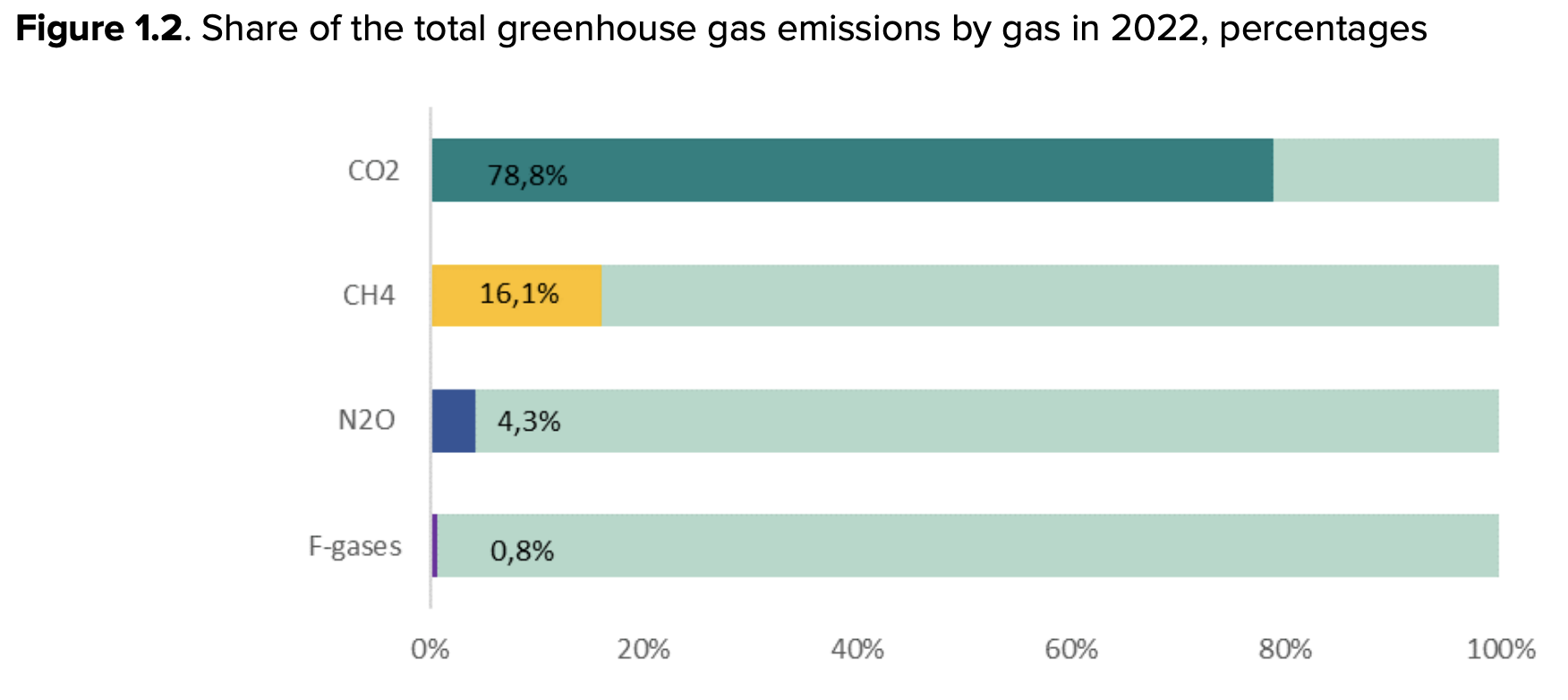

Source: https://unfccc.int/sites/default/files/resource/NID%20RK%202025.pdf, p. 29

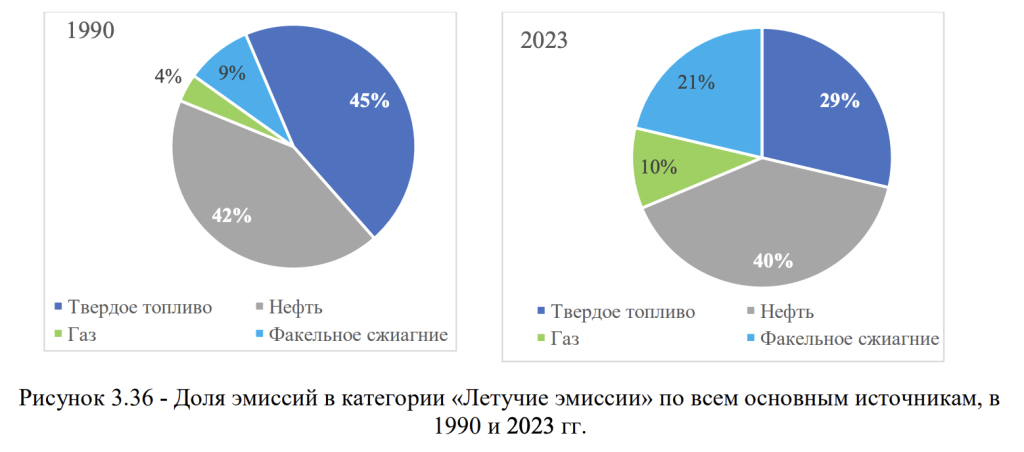
Source: https://unfccc.int/sites/default/files/resource/NID%20RK%202025.pdf p. 118
Among the main sources of fugitive emissions, flaring and venting accounted for 21% in 2023, making them a considerable source in this category. The share of fugitive emissions has increased to 16% since 1990.12 In comparison with flaring, venting became prevalent by 2023, a significant change since 1990.
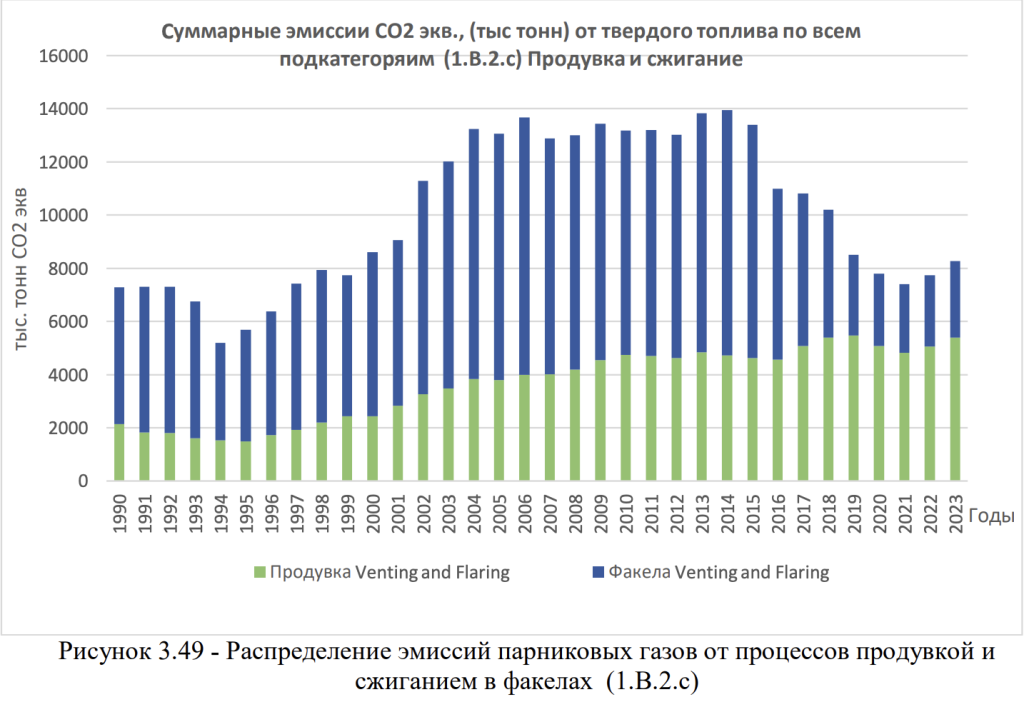
Source: https://unfccc.int/sites/default/files/resource/NID%20RK%202025.pdf,
p. 136
Before routine flaring was banned in 2004, associated gas was treated as waste and not refined; it was burned at flaring towers and oil wells. After 2004, associated gas was reinjected to boost oil and gas production.13
Despite Kazakhstan’s 2004 routine flaring ban, the country did not see an overall reduction in emissions. Instead, the country shifted the emissions burden down the supply chain rather than eliminating it at the source. Therefore, the reduction of flaring is a hollow metric, not a success, because it does not correspond to a decrease in the sector’s total GHG footprint.
Current UN Commitment
At the end of 2025, Kazakhstan submitted its National Determined Contributions (NDC 3.0) as part of mandatory reporting to the UNFCCC. It reported:
- Further growth in methane emissions is expected in the oil and gas and waste management sectors unless additional measures are implemented and executed to curb methane emissions.
- Methane abatement is considered a critical step in the climate mitigation process.
- NDC 3.0 sets a target of a 42% reduction in fugitive methane emissions in the energy and waste sectors by 2035.
- Kazakhstan promises to introduce a legislative framework for methane emissions, establish the National Methane Emissions Database, and create the National Methane Emissions Reduction Program.
In its NDC 3.0, Kazakhstan raises its climate mitigation target, with national net greenhouse gas emissions set to decline by 17%14 below 1990 levels by 2035 as an unconditional target,15 relying solely on domestic resources, and up to 25% with international support (conditional).
Before NDC 3.0, Kazakhstan’s commitment was to reduce GHG emissions by 15% by the end of 2030 relative to the 1990 base year (unconditional target) and by 25% relative to the 1990 base year (conditional target).
There is no current analysis of the sufficiency of the current NDC 3.0. Yet, Kazakhstan’s previous climate commitments were rated “insufficient” by the Climate Action Tracker due to rising emissions under Kazakhstan’s 2023 policies.
Other International Initiatives and Partnerships
Kazakhstan is a signatory to the Global Methane Pledge (GMP), officially joining at the COP28 in 2023. Under this commitment, the country is planning to achieve a collective 30% reduction in methane emissions by 2030. Because GMP is a voluntary commitment, reporting is primarily managed through existing international climate frameworks. Kazakhstan is part of many international and domestic commitments and initiatives that are meant to bring it closer to the GMP’s reduction goal.
The Fugitive Methane Emissions and Carbon Intensity Reduction Program is a collaboration between the European Bank for Reconstruction and Development (EBRD) and the government of Kazakhstan. It serves as a technical and financial engine to help Kazakhstan meet its commitment to the Global Methane Pledge. Under the program, EBRD supports Kazakhstan in modernizing natural gas pipelines and storage to eliminate venting, implementing Leak Detection and Repair (LDAR) technologies, and establishing the National Methane Emissions Database. The latter is in the development stage and is not available for public use.
Zero Routine Flaring Initiative (ZRF) through the World Bank Global Flaring and Methane Reduction Partnership (GFMRP) requires Kazakhstan to design and operate all new oil field developments in a way to eliminate routine flaring from the start of production; implement solutions to end routine flaring at legacy sites as soon as possible, and by 2030 at the latest; submit annual flaring data to the World Bank for public aggregation and transparency.
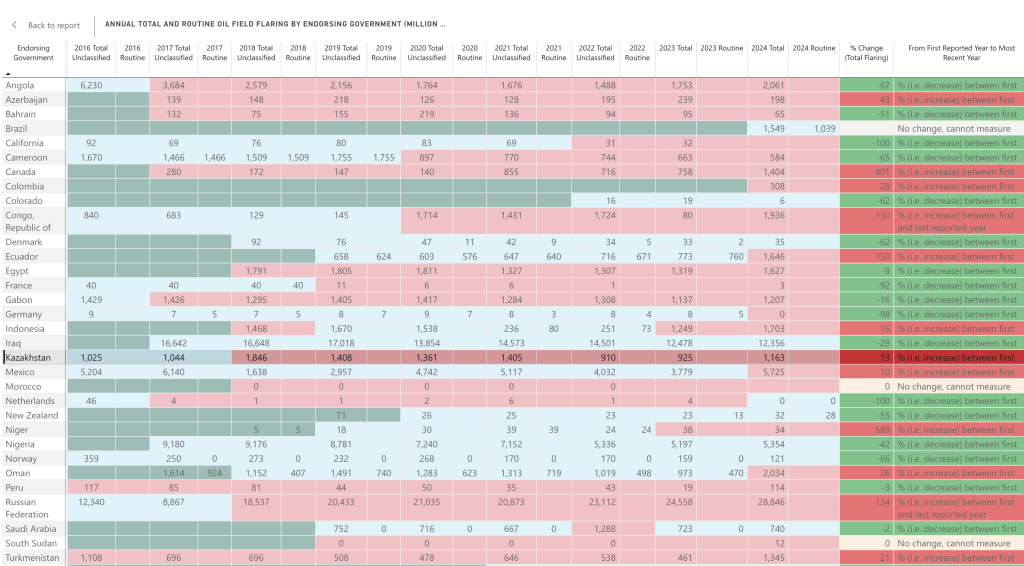
While some reports suggest Kazakhstan reduced routine flaring by 75% by outlawing the practice, one would expect to see a corresponding decline in total flaring. However, the data suggests otherwise.
Since 2018, Kazakhstan has not been reporting flaring data. In the absence of data from the government of Kazakhstan, the World Bank obtained data from satellite imagery. According to 2024 data, there has been a 13% increase in total and routine flaring in Kazakhstan since 2016. The World Bank’s satellite data suggest that a) Kazakhstan experiences significant non-routine flaring, emergency or technologically inevitable flaring, which became more frequent and larger in scale and b) routine flaring is masked under emergency and technologically inevitable flaring, thus becoming a routine practice.
Crude Accountability reached out to the World Bank for comment, regarding their data on Kazakhstan, but did not receive an answer.
At COP30 in Belém, Brazil, Kazakhstan joined a group of leading energy nations, including Canada, France, Germany, Japan, and Norway, in signing the statement: “Drastically Reducing Methane Emissions in the Global Fossil Fuel Sector.” This participation elevates Kazakhstan to the status of a regional leader in methane reduction. Key commitments from this document include near-zero intensity targets across the fossil fuel sector, ending routine flaring and venting by 2030, holding operators strictly accountable, implementing rigorous Measurement, Monitoring, Reporting, and Verification based on the Oil and Gas Methane Partnership 2.0 standards, using marketing levers, and establishing a panel to report on progress in 2026.
Through the Oil and Gas Methane Partnership 2.0 (OGMP 2.0), Kazakhstan commits to implementing the Measurement, Monitoring, Reporting, and Verification (MMRV) program. Under this standard, companies must directly measure emissions from specific emission components, use satellites, drones, or aircraft to measure emissions across an entire facility, and reconcile the two datasets. In addition, companies commit to annual public disclosure of methane emissions. Information is then independently verified by third parties or the International Methane Emissions Observatory (IMEO). Currently, KazMunayGaz (KMG), North Caspian Operating Company (NCOC), Karachaganak Petroleum Operating (KPO), and Tengizchevroil (TCO) have joined the partnership. The companies submitted their reports to UNEP under the partnership agreement, but they are currently not publicly accessible.
KazMunayGaz (KMG) is a state-owned company and also a signatory to the Oil and Gas Decarbonization Charter.
Memorandum of Cooperation on Methane Emissions Monitoring and Reduction between Global Methane Hub and the government of Kazakhstan stipulates that Kazakhstan develops a National Methane Action Plan, establishes a National Methane Office to coordinate cross-ministerial implementation, monitors progress toward GMP targets, leverages satellite technologies to detect and monitor high-emission sources, implements pilot projects, conducts training programs, and organizes a regional methane forum. The program is implemented in partnerships with Carbon Mapper and the Methane Alert Response System (MARS) to identify super-emitter events.
The Global Methane Initiative (GMI) is an international public-private partnership focused on “reducing barriers to the recovery and use of methane as a valuable energy source.” As part of the initiative, the partnership identifies opportunities for emission reduction and fosters best practices and effective policies. Through GMI, experts and decisionmakers share best practices, research, technology innovations, policy models, and real-world solutions that enable the successful implementation of methane mitigation policies and projects.
Together with the Climate and Clean Air Coalition (CCAC), Kazakhstan is developing a Short-Lived Climate Pollutant (SLCP)16 plan and a methane roadmap, aiming to integrate SLCP targets into NDC 3.0. Through CCAC, Kazakhstan is also implementing its Fossil Fuel Regulatory Program.
The Current Climate for Human Rights in Kazakhstan
Assessing Kazakhstan’s methane-reduction commitments requires consideration of the current human rights climate in the country. Implementation of methane reduction commitments requires civil society engagement, which affects all stages of the legislative, judicial, and executive processes, access to information, public participation, and access to justice in environmental matters, including tracking, monitoring, and reporting on methane emissions.
Kazakhstan’s systemic restrictions on civil liberties directly undermine environmental transparency and accountability. Current hindrances to the right to information prevent independent organizations from verifying government data and ensuring that Kazakhstan fulfills its national and international methane commitments.
Kazakhstan is increasingly restricting space for civil society: authorities use vague charges of “extremism” and “dissemination of deliberately false information” to persecute political opponents and activists like Marat Zhylanbaev,17 Bakhytzhan Toregozhina,18 Akylbek Muratbay,19 and many others. Rights to peaceful assembly and free speech are tightly controlled, while rhetoric about democratic reforms often solidifies the current power structure and leads to increased persecution of independent journalists, including Duman Mukhamedkarim,20 Daniyar Adilbekov,21 Lukpan Akhmedyarov,22 and many others.
On March 15, 2026, Kazakhstan adopted amendments to the constitution through a snap referendum that revised approximately 80% of the previous constitution and again exposed the undemocratic and repressive nature of the country’s regime.
At first, authorities reacted forcefully to public comments on the draft Constitution by cracking down on citizens who tried to share their criticisms. One man was fined for posting commentary on charges of spreading “false information”; two lawyers who publicly discussed the draft received warnings; the news site KazTAG was blocked after publishing highly critical commentary on the amendments; activist Ermek Narymbay was placed in pretrial detention; activist Zharkyn Kurentaev was detained prior to his participation in a conference regarding the draft of the Constitution.
The acceptance of the Constitution’s draft in a snap referendum on March 15, 2026, further erodes the protection of human rights. The Constitution now requires the public disclosure of information concerning the movement and assets of non-profit organizations from foreign countries or entities, as well as citizens, having chilling effect on civil society; provisions on freedom of speech are vaguely worded, which allows for further restriction of civil liberties: “Freedom of speech and freedom of information should not undermine the dignity of others, the health of citizens, and the moral character of society, and should not violate public order.”
- https://unfccc.int/sites/default/files/resource/NID%20RK%202025.pdf, p. 32 ↩︎
- Ibid., p. 29, 30, 31, 32 ↩︎
- Ibid., p. 29, 30, 31, 32 ↩︎
- Ibid., p. 32 ↩︎
- Ibid., p. 117 ↩︎
- Ibid., p. 118 ↩︎
- Flaring gas is sometimes necessary for safety reasons. During oil extraction, gas accumulates around oil, and before it is drilled, the gas must be removed. Sudden increases in pressure occur while gas comes to the surface, and explosions may occur if the pressure is not released. ↩︎
- Technologically inevitable gas flaring is flaring of gas essential for uninterrupted hydrocarbons production during commissioning, operation, maintenance, repair, as well as technological malfunctions, deviations or operational abnormalities of the equipment, within the limits and volumes permitted by the authorities. (Article 146, part 4) ↩︎
- https://adilet.zan.kz/rus/docs/Z040000002_, article 30-5. ↩︎
- An emissions trading system is a policy in which a government sets an upper limit of greenhouse gas (GHG) emissions, which can be emitted in defined sectors of the economy. The government issues allowances, which are given or sold to the entities that are included in the ETS. By the end of the defined period, entities that emitted fewer allowances can sell any excess to other participating entities. ↩︎
- CO2 equivalent ↩︎
- https://unfccc.int/sites/default/files/resource/NID%20RK%202025.pdf, p. 118 ↩︎
- https://unfccc.int/documents/627844 p. 167 ↩︎
- A 2% increase since previous commitment. ↩︎
- Target implemented with only domestic resources. ↩︎
- Methane is a major SLCP. ↩︎
- Marat Zhylanbaev is a Kazakhstani activist who was sentenced to seven years in prison for his peaceful political activities. In 2023, he was wrongly accused of extremism-related crimes, particular participating in an unregistered political opposition movement, Democratic Choice of Kazakhstan, which the court labeled as an “extremist organization” and banned, despite there being no evidence that the organization engaged in violence or promoted hatred. ↩︎
- Bakhytzhan Toregozhina is a prominent veteran human rights defender, leader of the organization Ar-Rukh-Hak, and member of national boards monitoring the status of political prisoners and prisoners of conscience. She has been harassed for her work, and was most recently detained and fined. ↩︎
- Akylbeck Muratbay is a Karakalpak human rights defender, community leader, and advocate living in exile in Almaty, Kazakhstan. He has been raising awareness about human rights violations against the Autonomous Republic of Karakalpakstan since 2022, when Uzbek authorities used military equipment to suppress protests calling for independence. Kazakhstan detained Akylbeck Muratbay for a year, and the activist is now at risk of extradition. ↩︎
- In 2024, journalist and political activist Duman Mukhamedkarim was sentenced to seven years of imprisonment on charges of financing and participating in a banned “extremist” organization, Democratic Choice of Kazakhstan. After working at Qazaqstan he founded a YouTube channel where he covered major political events and became one of the few to report on the 2022 Kazakh unrest. ↩︎
- Daniyar Adilbekov was sentenced to four and a half years in prison for spreading ‘false information’ and ‘knowingly false denunciation.’ The charges arose from his publication, where he alleged corruption risks involving Kazakhstan’s Vice Minister of Energy, EK Akkenzhenov. The publication also mentioned Yusuf Rashel Akjawder, the chairman of the board at Astana Airport, whose employees said he interfered with the airport’s operations. ↩︎
- Lukpan Akhmedyarov is a prominent Kazakh investigative journalist and human rights defender. He is a former editor-in-chief of the independent regional weekly newspaper Uralskaya Nedelya. He continues his work through his YouTube channel “Just Journalism” (Просто Журналистика), including reporting on corruption and the war in Ukraine despite facing criminal charges, detention, a past brutal assassination attack, and the blockage of his channel. ↩︎