
 Nathan Reynoso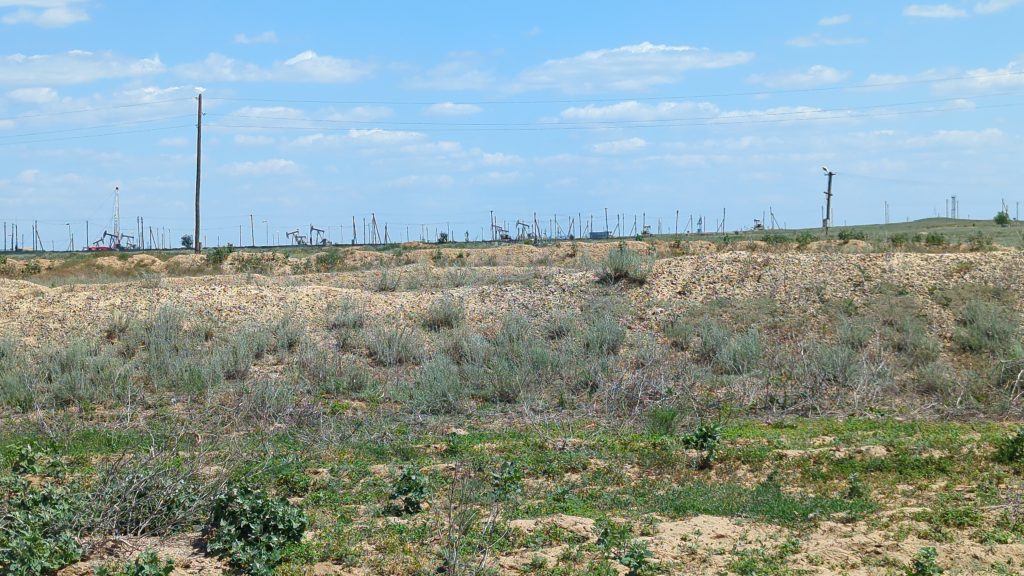
July 21, 2025
By Research Associate at Crude Accountability
In May 2025, I traveled to Kazakhstan with a team from Crude Accountability to the Kokzhide oil field and the nearby village of Kenkiyak to engage with residents and gain firsthand insights. The Kokzhide oil field is located on an underground aquifer, which is a source of drinking water for the population. Environmental monitoring tests at the oil field have repeatedly detected massive environmental violations. These results, along with significant public opposition to the oil field, led the government of Kazakhstan to decide to phase out oil and gas production at Kokzhide gradually.
As an environmental lawyer and advocate, I wanted to see the realities on the ground for myself. I had expected to confirm that the planned closure of oil wells was advancing on schedule and should have been decommissioned by the time of our visit. But what I saw told a very different story – one that sticks with me.
Flares, Health, Air, and Access to Information
Residents of Kenkiyak reported to us that flares burn mostly at night, illuminating the sky with bright orange flames. Locals call them foxtails. During the day, I witnessed giant, roaring flames spewing dense black smoke into the sky. Does this mean the flares are running 24/7? The air was heavy with a choking, acrid stench, like smoldering rubber and burning tires. Each breath felt toxic, and I was uneasy thinking about the oil workers who are probably exposed to this daily.
Both women and men had shared their health concerns with the village leadership and journalists: children suffering from respiratory problems, families facing high blood pressure, and elevated blood sugar levels.
According to official data for 2024, air pollution levels in Kenkiyak are estimated as Very High, and hydrogen sulfide (H2S) was 14.6 times higher than the maximum permissible concentration. Sulfur dioxide and nitrogen dioxide also exceeded the maximum permissible concentration.
Air monitoring data, which was previously accessible to the local population through a system installed near the local Akimat’s (mayor’s) office, is no longer available, according to a villager. In other words, hopes for transparency about toxic emissions have vanished, leaving villagers guessing about the safety of the air they breathe each day.
As one man explained, if villagers who work for the oil companies raise health or environmental concerns, they risk being reprimanded by their employers. It is a distressing but typical dynamic between fossil fuel companies and communities. For this exact reason, I do not share the names of the villagers we met.
Spurious Benefits
I never expected villagers to own castles with fountains, but frontline fossil fuel communities should live in dignity and receive equitable benefit sharing. At Kokzhide, companies provide token “benefit sharing” – building a school for 600 children, repairing roads, or replacing roofs – while continuing to exploit local land, health, and water resources, leaving current and future generations with polluted water, toxic air, and depleted resources. To me, these gestures feel spurious, serving only to silence criticism and keep the real costs of fossil fuel extraction hidden.
The Kokzhide Water Crisis: Corporation Dictates, Government Stalls, Community Resists
Following ongoing contamination of the water in the Kokzhide aquifer from 2019 to 2021, during which petroleum products were detected in every sample collected, the Office of the Attorney General of Kazakhstan increased its attention to environmental and health concerns raised by residents and civil society organizations about the violations at the field.
CNPC–AktobeMunaiGas JSC, KmK Munai JSC, and Ada Oil LLP, the companies active at the field, were fined in 2021, but the unique Kokzhide aquifer remains in jeopardy. Although the villagers described the water quality as “fine” and “drinkable,” they were unaware of any water tests to support this claim. Official information from the 2023 Kokzhide inspections, however, contradicts this. All five operating oil companies were fined for numerous violations, including groundwater contamination. The oil companies challenged this in court and, sadly, won the case in 2024.
The boundaries of the Kokzhide protected area, which include the sands and the underground aquifer, remain outdated despite new research determining the actual location of the aquifer that needs to be protected. The edges of the aquifer extend beyond the protected area, which creates risk to the integrity of the aquifer itself. The government’s procrastination in expanding the area for adequate water protection is likely due to the presence of existing oil wells within the proposed new boundaries of the reserve.
I found discrepancies in official documents that provide the number of wells in the Kokzhide region, with estimates ranging from 331 to 785. Accessing and verifying information on closed oil wells and those planned to cease production by 2032, along with agreements between the Kazakh government and companies, proved challenging. This secrecy and confusion underscore a lack of accountability and transparency.
So far, only four oil wells have been closed, and those were emergency wells that did not contribute to oil production. Five oil wells are behind schedule for decommissioning, and forty-nine are planned to close in 2025. When I asked locals if they had noticed any difference in the water and air quality, they shook their heads with quiet resignation. Crude Accountability was also informed that companies may have benefited from these closures, as the wells had insufficient output anyway.
Oil companies and all levels of government have intertwined relationships in business deals. This paralyzes public governance, overshadowing the true value of human health and nature.
Still, the community resists. Villagers raise pollution issues with the Akimat and the federal government. I admire their courage, knowing that even small acts of resistance and dissent remain risky in Kazakhstan.
Who Will Be the Good Guy?
Ultimately, in this system, only government authorities can effectively resolve the multiple environmental and health issues related to oil and gas production at Kokzhide. Companies will comply only if there is political will that pushes them to do so.
If the corporate and government structures complied with legal and sound economic principles such as access to information, stakeholder engagement, equitable benefit sharing, sustainable development, and a just transition, the world would be so much better; not just for communities, but also for oil executives and officials – after all, they are humans, too.
Standing on Kokzhide’s steppe, breathing its toxic air, I wondered: How long can we keep choosing oil over life itself?